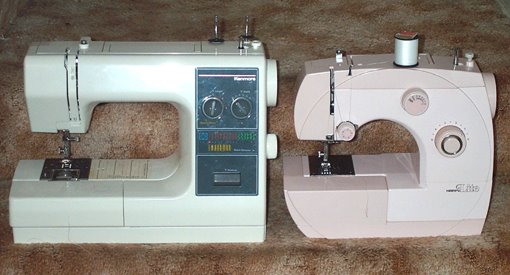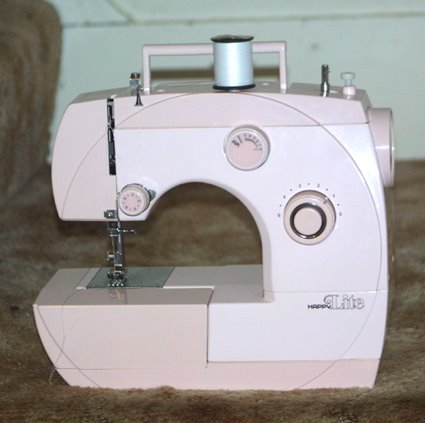
For less than $12 including shipping, I purchased this cute little machine off Ebay. I am now the proud owner of a Montgomery Ward HappyLite Sewing Machine (Model 1837). It is pale pink in color (was also available in turquoise blue), weighs about 8lbs, and has the same dimensions (13W x 10.5H x 5.5D) as the Janome 3125. The Happy Lite uses regular size bobbins, needles, and presser feet. It is designed with a free-arm sewing surface when the extension table is removed. According to the manual, it's capable of sewing delicate, light, medium, and heavy-weight fabrics. When originally shipped from the factory, the following items were included:
- 3 machine needles
- Bobbin
- Felt washer to be placed under the thread spool (missing on mine)
- Large screwdriver
- Small screwdriver (missing)
- Satin stitch foot (missing)
- Dust cover, which has a little pocket for the manual
- Manual
 I have a full size Kenmore sewing machine that works wonderfully, but I wanted something small that I could use when I had small projects that needed to be done.
The HappyLite does 7 basic stitches, including straight, zig-zag, stretch, and rickrack. It also does reverse stitching. It's also capable of doing buttonholes, but I doubt if I'd use it for that.
 This seems to be a well-built little sewing machine with basic capabilities. The only plastic parts are the knobs and the extension table. The only negative to this machine is that there is no task light. I plan on getting it serviced/tuned up and then using it for light sewing. It's also the perfect size to teach my younger nieces how to sew. If anyone has additional information or history on this machine, please let me know. Chances are slim, but I'd really like to find additional accessories such as:
- straight stitch foot (#2387)
- narrow hemming foot (#2388)
- zipper foot (#1028)
- satin stitch foot (#SM718)
- automatic buttonholder (#9259)
I have learned that the machine is possibly 16 years old and may have been manufactured by Happy Industrial Corporation in Japan (The back of the machine says: Made in Taiwan) and sold by Happy America Corp., 4705 Hydraulic Rd, Rockford, IL 61109. The Happy America Corp was established in 1978 in order to sell to Montgomery Ward.
If anyone is in need of a copy of the out-of-print manuals, I have them for sale. Leave a comment with your email address and I'll get back to you.